
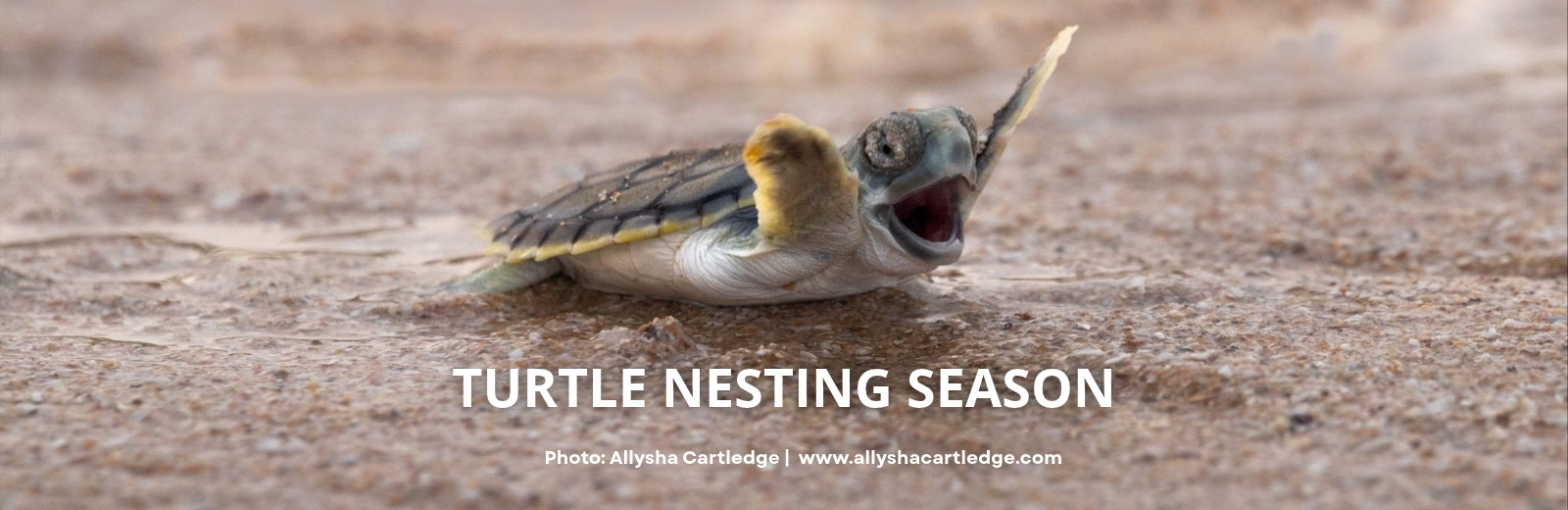
Flatback turtles are unique to Australia. The main turtle species that nests on Broome’s Cable Beach is the flatback turtle (Natator depressus), a species found only in Australian waters. Cable Beach is one of their important nesting sites along the Kimberley coast. Recognised by their smooth, flat shells and olive-grey colouring, flatback turtles prefer shallow coastal waters and reefs close to shore.
While flatbacks are the main nesters, green and hawksbill turtles are occasionally spotted in the region, adding to the area’s rich marine diversity.
Every year sea turtles nest on Walmanyjun (Cable Beach) from October - March with hatching occurring approximately 7 weeks after the eggs are laid.
------------------
Community Turtle Monitoring Program
The annual Cable Beach Community Turtle Monitoring Program records daily nesting activity across a 6km stretch of the beach, officially kicking off its monitoring efforts on 1 November. This an annual 7-week flatback turtle community monitoring program. Applications usually open in September each year and will be shared via Kimberley Parks and Wildlife Facebook page. This year applications closed on Thursday the 8th of October 2026.
------------------
As a volunteer, your morning monitoring walk will begin at approximately 5.00am and can last a couple of hours depending on the turtle track activity of the night/early morning before. You will be looking for tracks, nests, false crawls and any potential nest disturbances (which you will learn about at the training). You will be walking along Cable Beach on soft sand over a sector of approximately 4-6km (return). This volunteer program contributes to the Northwest Shelf Flatback Turtle Conservation Program.
------------------
Monitoring Turtle nests
Parks and Wildlife Service, Kimberley will be working together with the volunteers to monitor nesting activity, collect vital data, and ensure our beaches remain safe and respectful spaces for turtles and community alike. Trained volunteers are monitoring Walmanyjun (Cable Beach) for tracks and nesting activity. Nests will be marked with signs or flags, if you see one, please give it space and avoid disturbing the area.
Read more about Flatback conservation
------------------
Turtle-friendly lighting installed as part of the Walmanyjun Cable Beach Foreshore Redevelopment
During turtle nesting season, all foreshore lighting, including handrail lights, bollards, and light posts, automatically switches to a red-orange colour mode. This special light spectrum has a restricted wavelength and lower intensity, meeting Australian Standards and the National Light Pollution Guidelines for Wildlife. The softer red-orange glow helps nesting turtles and hatchlings find their way to the ocean while keeping the foreshore safe and accessible for people. The lighting system is fully automated and managed by the Shire of Broome. It operates with warm white light outside of turtle season and changes to red-orange mode from dusk to dawn during nesting months. Each light is carefully positioned to direct illumination downwards and away from the beach, reducing light spill and keeping the natural night-time environment. No light shines directly onto the beach. This design allows the community and visitors to enjoy the foreshore at night while protecting Broome’s turtle population for future generations.

------------------
Protecting turtles - what you can do
• Avoiding driving on the beach.
• Following the ‘Turtle Watching Code of Conduct’ if you see a turtle
• Refraining from touching or interacting with turtle hatchlings
• Dogs should be kept away from turtle nesting beaches.
------------------

DID YOU KNOW?
Of the seven marine turtle species found globally, five species are known residents and migrants to the marine park: the flatback (Natator depressus); green (Chelonia mydas); loggerhead (Caretta caretta); olive ridley (Lepidochelys olivacea); and hawksbill (Eretmochelys imbricata). Gurlibil (green turtles) are culturally significant to Yawuru people. Turtles nest on beaches within Yawuru parks.
Source: Yawuru Marine and Conservation Parks guide
------------------
Shire information and vehicle access ramp closure
The Cable Beach vehicle access ramp is now closed as part of Stage 2 of the Walmanyjun Cable Beach Foreshore Redevelopment and will remain closed until mid to late 2026.
There will be no vehicle access point onto Cable Beach to North of the Rocks, with pedestrian access only to North of the Rocks and camels via the Surf Club beach access point. Pedestrian access to North of Rocks and camels via Surf Club and Cable Beach House staircases to the beach. Gantheaume Point Beach, near the Broome Turf Club, has temporarily extended the area that permits vehicles on the beach.
The gate installed at the Cable Beach Amphitheatre is locked. Emergency vehicles and those used for essential Council and Ranger services, and relevant licenced businesses will be permitted to operate on the beach when necessary.
Penalties of up to $200 apply for anyone disregarding the beach closures under Shire of Broome Local Laws.
The Shire of Broome appreciates the community's co-operation in assisting to protect marine turtles on Cable Beach.
For more information about access to Cable Beach North, visit https://www.broome.wa.gov.au/cablebeachramp
Read more about Turtle friendly beach driving techniques
Flatback turtles are native to Broome and special to the Yawuru people. They are also a threatened and vulnerable species and are therefore legally protected.

------------------
Turtle Watching Code of Conduct
The Department of Biodiversity, Conservation and Attractions and Parks and Wildlife Service encourage everyone to follow the code of conduct. DOWNLOAD PDF

------------------
Broome Visitor Centre
Have questions or want to find out more? Come in and see the friendly team at the local visitor centre.

------------------
Main Photo credit: Allysha Cartledge www.allyshacartledge.com
------------------